

Why do some leaders build teams full of initiative, innovation, and ownership while others unintentionally create bureaucracy, micromanagement, and disengagement? It isn’t usually intelligence. It isn’t experience. It isn’t personality. I believe it comes down to two simple questions:
Do you trust your team?
Do you trust yourself?
Most leadership conversations stop after the first question. We hear that great leaders trust their people. That’s true, but it’s only half of the story. The other half receives surprisingly little attention.
Great leaders trust themselves. Not in an arrogant way. Not because they think they have all the answers. They trust themselves enough to make difficult decisions, establish direction, withstand criticism, and allow talented people to contribute without feeling threatened by them.
These two forms of trust interact in ways that shape every aspect of a team’s culture. That realization led me to develop what I call the Confidence-Control Matrix.
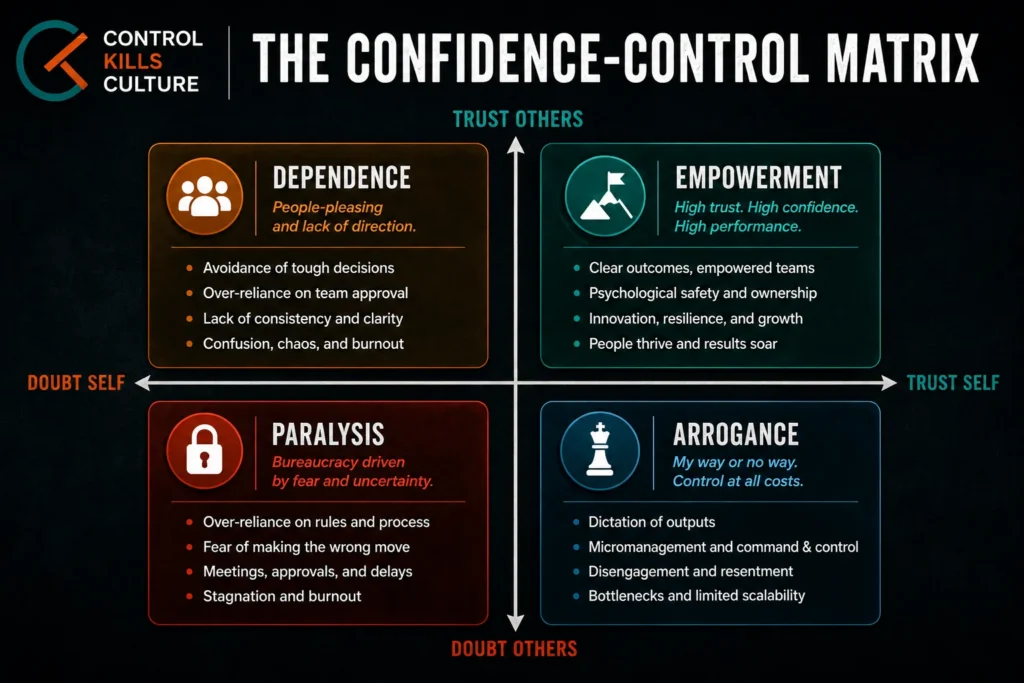
The matrix measures only two things.
- Trust in others.
- Trust in yourself.
That’s it.
Yet those two variables create four dramatically different leadership environments.
When Leaders Trust Themselves but Not Their Team
This is the trap many leaders fall into. They believe they’re maintaining standards.
Their employees experience micromanagement.
Every important decision comes through the manager. Approval becomes the default. Initiative slowly disappears because people learn that independent thinking simply creates more work.
The leader becomes the bottleneck.
Employees become compliant.
Innovation slows.
The leader often concludes that even more control is necessary, never realizing that the control itself is creating the very problems they’re trying to solve.
When Leaders Trust Neither Themselves nor Their Team
Some leaders don’t trust themselves enough to make difficult decisions, but they also don’t trust others.
So where do they turn?
Rules. Policies. Processes. Bureaucracy becomes their security blanket.
When uncertainty appears, the answer isn’t thoughtful leadership. It’s another approval. Another meeting. Another policy. Another committee.
Nobody feels empowered because everyone is waiting for permission from someone else. The organization slowly loses its ability to think.
When Leaders Trust Their Team but Doubt Themselves
This quadrant often looks healthy at first. The leader gives people freedom. They’re supportive. They’re kind.
But they’re also hesitant.
They avoid conflict. They hesitate to establish direction. They change course depending on who spoke most recently.
Employees appreciate the freedom until they realize no one is actually leading.
Without confidence, empowerment eventually turns into confusion.
When Leaders Trust Both Themselves and Their Team
This is where remarkable cultures are built.
Leaders establish outcomes instead of dictating every step. They provide direction without controlling every decision. They ask questions more often than they give orders. Mistakes become learning opportunities instead of reasons for blame. People speak openly because psychological safety exists.
Ownership spreads throughout the team.
Innovation accelerates because every brain in the organization is working instead of just one.
This is the Quadrant of Empowerment.
It doesn’t produce perfect organizations. It produces organizations that continuously improve.
The Goal Isn’t Perfection
Every one of us has probably led from more than one quadrant. Leadership changes with stress. With experience. With fear. With confidence.
The goal isn’t to label ourselves. The goal is to recognize our tendencies so we can move toward empowerment. The most effective leaders trust themselves enough to let go. They trust others enough to share ownership.
That combination unlocks something extraordinary. Instead of creating employees who wait for instructions, they create people who think. And when more people are allowed to think, organizations become stronger than any single leader could ever make them.
That is the purpose of the Confidence-Control Matrix.
In coming articles, we’ll explore each quadrant individually: why leaders end up there, what it feels like to work in those cultures, and, most importantly, how to move toward empowerment.