
Imagine trying to solve difficult puzzles while a jackhammer pounds relentlessly outside your office window. The noise is distracting. Jarring. Emotionally exhausting.
Now imagine there is absolutely nothing you can do to stop it. No switch. No escape.
No control.
How long do you think you would stay calm? How well would you perform? How long before irritation turns into exhaustion?
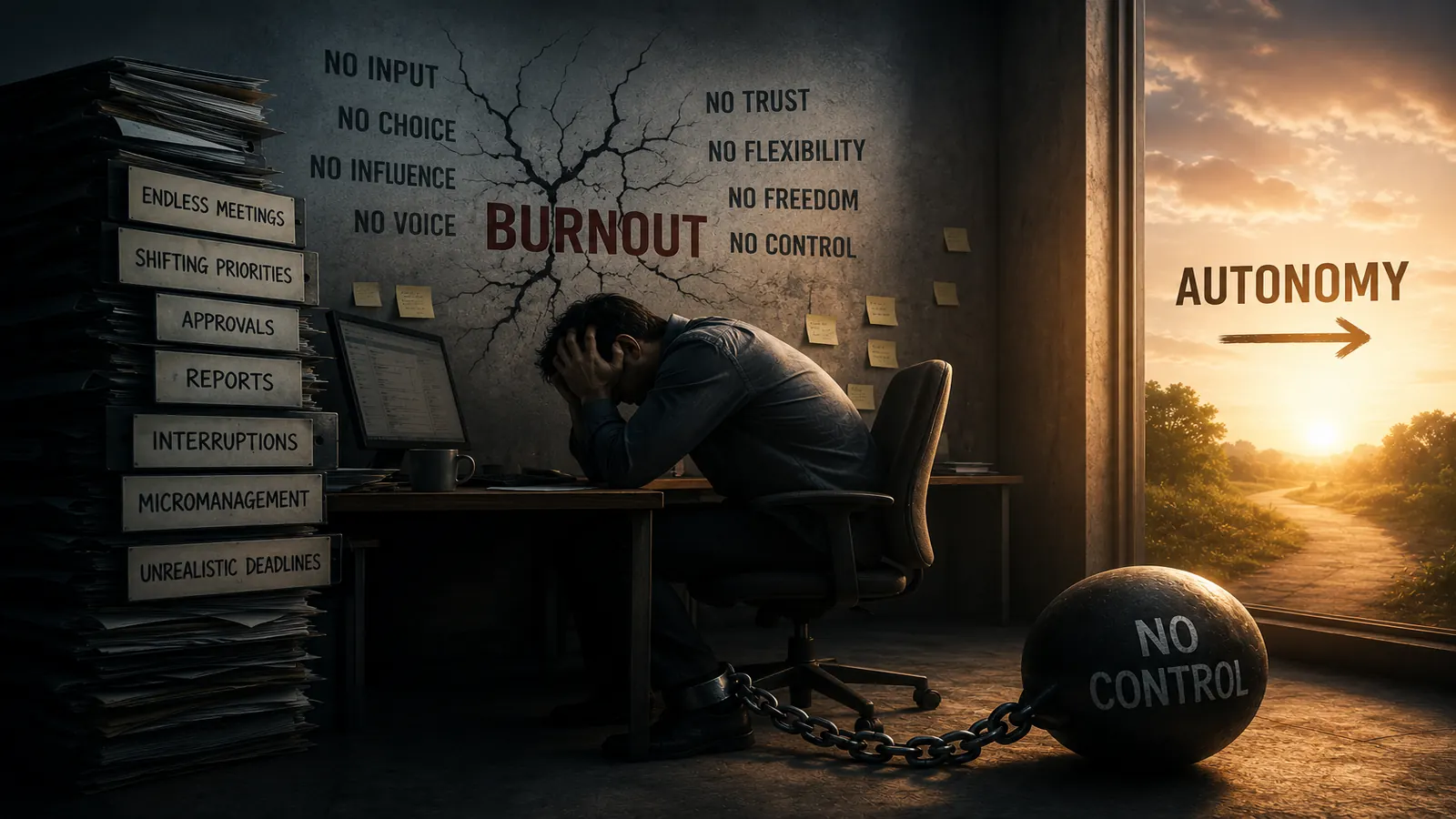
This feeling is closer to modern work than many leaders realize. Employees today are surrounded by workplace “noise”: shifting priorities, endless meetings, constant notifications, unrealistic deadlines, bureaucracy, interruptions, micromanagement, and pressure that never fully goes away.
Most organizations assume burnout happens because employees are overloaded. I think they are only partially right. Burnout often begins somewhere deeper.
Burnout begins when people lose control.
Stress Is Not the Enemy. Powerlessness Is.
Psychologists David Glass and Jerome Singer wanted to understand something fascinating: Does it matter whether people have control over the stress around them, even if they never actually use that control?
Their experiment was simple. Participants were asked to complete problem-solving tasks while random bursts of loud noise blasted through the room. One group was given a button. If they wanted, they could press it and stop the noise immediately. The other group had no button. No escape. No control.
The results were remarkable.
The participants without control became significantly more stressed, frustrated, and less effective at completing their tasks. Here is the fascinating part: Many participants with the button never pressed it. They endured the exact same noise. Yet they experienced dramatically less stress.
Why?
Because they knew they had a choice. The issue was never merely the noise. It was the absence of control. A loud noise is irritating. A loud noise you cannot escape becomes emotionally corrosive.
Modern Work Is Full of Noise
Employees experience noise every day. Not literal noise. Organizational noise. A surprise meeting. A priority change. An approval process. A new report. A policy. A sudden deadline. A manager rewriting work.
None of these things alone necessarily break people, but together, when employees feel they have absolutely no influence over their environment, something changes. Stress becomes suffocating. People stop feeling like participants in their work. They start feeling trapped inside it. That trapped feeling matters more than many leaders realize.
Burnout Is Often Less About Hours Than Helplessness
Many people assume burnout means working too many hours. Hours matter, but they are not the whole story. Human beings can endure extraordinary levels of challenge when they feel ownership. Athletes voluntarily push themselves to exhaustion. Entrepreneurs work insane hours. Parents endure sleepless nights. People tolerate enormous stress when they feel agency.
But take away control?
Everything changes.
What was difficult becomes unbearable. What was stressful becomes exhausting. What was meaningful becomes draining. Micromanagement accelerates this process. Not because employees become weaker, but because human beings were not built to function indefinitely under conditions of low autonomy.
Emotional Weather Becomes Psychological Climate
Emotional well-being and psychological well-being are closely connected. Emotional well-being is the weather. Psychological well-being is the climate. A stressful day happens. A stressful year changes people. Unchecked emotional strain slowly transforms: stress becomes burnout, frustration becomes hopelessness, distraction becomes emptiness, unhappiness becomes depression.
Research by Finnish researcher Kirsi Ahola and her team explored this connection. They studied employees experiencing high job strain: high demands combined with low autonomy. Some workers continued as usual. They were the control group. Others participated in interventions designed to restore agency. These employees learned to identify stressors, recognize where they felt trapped, negotiate boundaries, adjust schedules, create small areas of ownership, and support each other.
The result?
The likelihood of developing depression dropped dramatically. Not because work disappeared. Because autonomy returned.
Autonomy is not a workplace perk. Autonomy is psychological oxygen.
Why Control Creates Burnout
Control-heavy environments often create people who feel watched, overruled, politically exposed, emotionally cornered, and unable to influence outcomes. Eventually people stop trying. Not because they are lazy, but because they no longer believe effort changes anything.
This is where leaders often get confused. They see withdrawal and think: Lack of motivation. But many burned-out employees are not unmotivated. They are exhausted from prolonged powerlessness.
Practical Ways Leaders Reduce Burnout
If burnout accelerates when people lose control, what helps?
1. Give Employees More Decisions To Own
Even small choices matter. Choice restores agency. Agency builds resilience.
2. Reduce Unnecessary Control
Ask:
- What approvals could disappear?
- What meetings could disappear?
- What reports add little value?
Remove friction.
3. Allow Healthy Pushback
Employees need permission to say:
- This timeline isn’t realistic.
- I need help.
- There may be a better way.
That isn’t resistance.
That is ownership.
4. Stop Mistaking Visibility for Control
Knowing what employees are doing is not the same thing as helping them succeed. More oversight is not always more support.
5. Build Trust Before Accountability
Accountability without trust creates fear. Trust creates ownership. Ownership creates resilience.
Burnout Begins Long Before People Quit
Most burnout does not arrive dramatically. It accumulates quietly. One unnecessary approval at a time. One ignored concern at a time. One decision removed at a time. Eventually people stop believing they can influence their circumstances. When people lose that belief, emotional exhaustion accelerates.
Human beings can endure tremendous pressure, but when they feel trapped, controlled, and powerless, even small stressors become unbearable. Burnout does not begin when work becomes difficult.
Burnout begins when people lose control.